 Rohman
Among Windows system administrators, municipal civil engineers, and legal support staff, Tracker Software’s flagship utility holds near-mythic status. While Adobe Acrobat bloated into a multi-gigabyte background-service juggernaut with aggressive recurring subscriptions, Tracker Software took the opposite path for two decades: hand-crafted C++ compiled directly to the Win32 API, instant file rendering, and perpetual desktop licensing. Yet every month, hundreds of thousands of professionals search for a pdf xchange editor alternative. They are not looking for a different tool because Tracker Software builds poor software; they are looking because modern office workflows have fundamentally outgrown the Windows desktop perimeter.
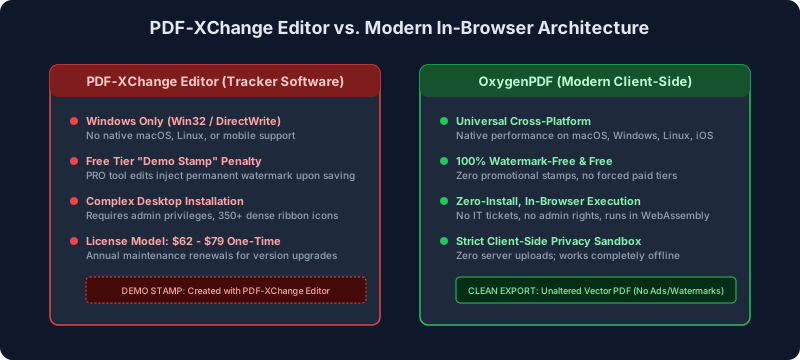
The breaking points emerge immediately upon leaving a dedicated Windows desktop. Tracker Software has never built a native macOS version, leaving Mac users stranded with buggy emulation layers that stutter during trackpad scrolling and mangle high-DPI Retina typography. Meanwhile, those searching for pdf xchange editor free frequently encounter the software's most notorious trap: an evaluation mode that presents full editing features but permanently burns destructive "Demo Stamp" watermarks across contracts the moment an unlicensed user hits save. For modern teams operating across macOS, Windows, Linux, and locked-down corporate laptops, the solution is no longer another heavy desktop installer. It is zero-install, client-side WebAssembly execution that delivers professional editing power directly inside your browser through tools like Edit PDF.
1. The Lineage: Why Windows Power Users Revere Tracker Software
To understand why replacing PDF-XChange Editor requires careful evaluation, one must acknowledge what Tracker Software got right. Founded in 1997 by John Walter on Vancouver Island, British Columbia, Canada, Tracker Software Products earned its reputation during the chaotic transition between Adobe Reader 6.0 and 8.0. During that era, Adobe's desktop reader became infamous for glacial load times, frequent memory leaks, and invasive browser toolbar bundles.
In response, Tracker Software released PDF-XChange Viewer, an ultra-compact, portable Windows executable that opened massive blueprint schematics in milliseconds. In late 2012, Tracker completely re-engineered its core rendering engine to introduce PDF-XChange Editor, superseding the legacy Viewer with a modern 64-bit Direct2D pipeline adhering strictly to ISO 32000-1 (PDF 1.7) and ISO 32000-2 (PDF 2.0) standards.
TRACKER SOFTWARE PRODUCT EVOLUTION:
[1997: Company Founded] ──> [2005: PDF-XChange Viewer Launches]
                                         │ (Fast, lightweight Acrobat alternative)
                                         ▼
[2012: PDF-XChange Editor Rewritten] ──> [2026: Version 10.x Active]
  • Low-level Win32 / Direct2D engine
  • Calibrated engineering measurement tools
  • Dual-engine OCR (Tesseract + ABBYY FineReader)
For specialized technical professions, PDF-XChange Editor remains exceptionally capable:
- Engineering and Architectural Scale Calibration: Civil and mechanical estimators rely heavily on its calibrated perimeter, area, and polygon measurement tools. A user can set a drawing scale (such as $1/4\text{ in} = 1\text{ ft}$) and snap measurements directly to CAD vector endpoints embedded within the PDF.
- Dual-Engine Text Recognition: Unlike standard consumer utilities that rely exclusively on basic Tesseract OCR, PDF-XChange Editor Plus bundles an enterprise-grade ABBYY FineReader OCR module for complex multilingual text recognition and skewed historical scans.
- Granular ISO Annotation Dictionaries: The software provides full access to underlying PDF specification dictionaries, allowing power users to inspect raw content stream operators, edit interactive JavaScript form scripts, and manage hierarchical comment trees.
- Minimal Hardware Consumption: Where modern Electron-wrapped PDF editors consume $1.5\text{ GB}$ of RAM simply idling on an empty workspace, PDF-XChange Editor rarely exceeds $150\text{ MB}$ to $250\text{ MB}$ while navigating a 2,500-page municipal zoning code.
2. The 2026 Licensing Model and The "Demo Stamp" Watermark Trap
Unlike Adobe, Nitro, and Foxit—which systematically eliminated perpetual licensing in favor of mandatory monthly cloud subscriptions—Tracker Software continues to offer perpetual standalone licenses with optional annual maintenance renewals:
| Commercial Tier | Single-User Retail Price | Core Capabilities Included | Key Restrictions & Omissions |
|---|---|---|---|
| Free / Evaluation | $0.00 | Document viewing, full-text search, basic highlight/comment markup, bookmark management. | The Demo Stamp Trap: Over 30 advanced "PRO" features inject permanent promotional watermarks when saved. |
| PDF-XChange Editor (Standard) | $62.00 (one-time) | Full text editing, page restructuring (split, merge, rotate, reorder), basic Tesseract OCR, document sanitization, digital signatures. | Excludes dynamic form creation, advanced ABBYY OCR engine, and automated document comparison. |
| PDF-XChange Editor Plus | $79.00 (one-time) | All Standard features, plus: dynamic fillable AcroForm creation, ABBYY FineReader Enhanced OCR, side-by-side comparison, Bates numbering. | Desktop Windows installation only; no cross-platform mobility. |
| PDF-XChange Pro (Suite) | $123.00 (one-time) | Editor Plus, PDF-Tools (automated batch processing pipeline), and PDF-XChange Standard virtual print spooler. | High complexity; redundant for teams operating modern web workflows. |
| Maintenance Renewals | ~20% to 30% / year | Unlocks new major version releases, technical bug patches, and priority helpdesk tickets. | If lapsed, license remains locked to the last major version released during the active maintenance window. |
The Free Tier Dilemma
The primary source of user friction is the deceptive architecture of the evaluation edition. When a user downloads pdf xchange editor free, the software does not disable premium capabilities. Instead, it exposes the complete suite of over 350 ribbon controls, subtly flagging licensed tools with a tiny blue or yellow "PRO" icon.
THE DEMO WATERMARK WORKFLOW:
1. User opens a legal brief or contract in the free evaluation download.
2. User utilizes a "PRO" feature (e.g., editing text, adding a form field, or deleting a page).
3. The editor allows the modification and displays a subtle infobar banner.
4. User clicks "Save" or "Save As" to finalize the urgent document.
5. DESTRUCTIVE RESULT: Permanent promotional demo stamps are written into the PDF binary.
The moment an unlicensed user saves a file after touching a PRO feature, the application executes a destructive binary injection:
- Visual Defacement: Large, high-contrast promotional banners are stamped across the top corners or diagonally across the center of every modified page, reading:
"Created with PDF-XChange Editor - www.pdf-xchange.com - Click to Buy Now!" - Binary Content Stream Modification: Under the hood, the software injects permanent Form XObjects (
/XObject) into each page’s/Resourcesdictionary, appends drawing operators (q ... /Im1 Do Q) to the page/Contentsstream, and registers clickable URI Link Annotations (/Subtype /Link) pointing directly to Tracker Software's checkout cart. - Permanent Alteration: Once saved, these promotional marks cannot be removed using the free version. Even if the user deletes the edited text, the demo stamps remain hardcoded into the content stream. Tracker Software's documented official remediation is straightforward: Purchase a $62 license key, reopen the defaced file, and select Organize > Watermarks > Remove All.
If you have already fallen victim to an unintended evaluation stamp, you do not have to pay for a desktop license simply to clean up your file. Specialized client-side utilities like Remove Watermark can inspect the PDF object tree and strip out third-party watermark XObjects without compromising underlying document typography.
3. The Platform Wall: Why "PDF-XChange Editor for Mac" Does Not Exist
By far the largest segment of frustrated users consists of professionals searching for pdf xchange editor for mac. The reality is absolute: Tracker Software does not build, support, or plan a macOS or Linux release. In developer community forums, the company's engineering leadership has confirmed that a native Unix/macOS build is outside their roadmap.
The reason is architectural. PDF-XChange Editor is not written in an abstraction framework like Qt, Flutter, or Electron. It is deeply entwined with native Windows platform APIs:
- The user interface relies on Windows Common Controls, Win32 message loops (
HWND), and Windows Shell integration. - Vector rendering utilizes Microsoft Direct2D and DirectWrite for font rasterization.
- Document printing hooks into the Windows Print Spooler (
winspool.drv) and Windows GDI graphic device contexts.
Porting the application to macOS would require discarding virtually all non-core C++ code and rewriting the software from the ground up using Apple's AppKit/SwiftUI, CoreGraphics (Quartz 2D), and Metal. Tracker Software has determined that its development capacity is better spent maintaining its Windows enterprise footprint.
+-------------------------------------------------------------------------+
| WHY WINE & CROSSOVER EMULATION FAILS ON MACOS                           |
+-------------------------------------------------------------------------+
|                                                                         |
|  [DirectWrite Font Conflict] ──> Jagged text rendering on Retina screens|
|                                                                         |
|  [Discrete WM_VSCROLL Messages] ──> Stuttering trackpad momentum scrolling|
|                                                                         |
|  [WinSpool -> CUPS Translation] ──> Clipped print margins & lost vectors|
|                                                                         |
|  [x86_64 -> ARM64 Emulation] ──> Severe battery drain on Apple Silicon |
|                                                                         |
+-------------------------------------------------------------------------+
The Emulation Failure: Wine, CrossOver, and Parallels
Mac users often attempt to run PDF-XChange Editor on macOS using compatibility layers such as Wine, CrossOver Mac, Whisky, or virtual machines like Parallels Desktop. While the application may launch, empirical daily testing reveals substantial friction points:
- Subpixel Font Blurring on Retina Displays: Windows DirectWrite subpixel anti-aliasing assumes physical RGB subpixel striping on traditional desktop monitors. When translated through Wine onto Apple’s high-density Liquid Retina displays, font glyphs display chromatic aberration, color fringing, and blurry edges.
- Trackpad Scrolling Disorientation: macOS users expect continuous, fluid inertia panning. Win32 desktop applications expect discrete mouse wheel tick messages (
WM_MOUSEWHEEL). In Wine, scrolling through a document feels jerky and stepped, making it difficult to read technical blueprints or long contracts smoothly. - Printing and Spooler Translation Errors: macOS routes print jobs through the Common UNIX Printing System (CUPS). Translating virtual Win32 GDI print calls through Wine to a networked CUPS printer frequently drops vector line weights, clips margins, or yields blank pages.
- Apple Silicon Virtualization Overhead: Running PDF-XChange Editor on modern M-series Macs (M1 through M4) requires translating x86_64 Windows binaries into ARM64 instructions via Rosetta 2 alongside Wine API translation. Running a full Windows 11 ARM instance inside Parallels Desktop to execute a PDF editor consumes 4 CPU cores, 8 GB of RAM, and 25 GB of storage, draining laptop batteries rapidly.
4. UI Complexity and Corporate IT Friction
Even in pure Windows environments, PDF-XChange Editor faces growing pushback from modern enterprise teams due to two structural liabilities:
Interface Cognitive Overload
The software reflects an older philosophy of software design where every possible capability is represented by a persistent toolbar button. The standard interface presents nine main ribbon tabs, housing dozens of cascading menus, property inspectors, and sub-panels.
Simple operations—such as redacting a Social Security number or applying a digital signature—require deciphering dense technical menus containing options like Transform Annotations, Flatten Form Fields, Set Base Line Shift, and Redefine MediaBox vs. CropBox. For business professionals, legal clients, and executive teams who need to complete a task quickly, the cognitive burden is unnecessarily high.
Enterprise Deployment Barriers
In corporate, financial, and healthcare settings governed by strict IT compliance:
- Local Administrator Credentials Required: Distributed as traditional
.msiand.exeinstallers, PDF-XChange Editor cannot be installed by standard end-users on locked-down corporate laptops without formal IT support tickets. - Persistent Background Services: The software installs auxiliary background updater agents (
Tracker Software Update Agent) that monitor network connections for patch releases, triggering alerts in corporate security monitoring suites. - Update Drift: In organizations without centralized SCCM/Intune packaging, individual workstations quickly drift across incompatible point releases, leading to inconsistent document rendering across departments.
5. Comprehensive Comparison: The Top 6 PDF Editor Paradigms in 2026
When evaluating an alternative to PDF-XChange Editor, knowledge workers generally choose among six distinct software categories. The matrix below outlines how these options compare across platform support, security architecture, pricing, and feature sets:
| PDF Editor | Primary Platform | Deployment Model | Pricing Structure (2026) | Security / Privacy Profile | Best Suited For |
|---|---|---|---|---|---|
| PDF-XChange Editor | Windows Only | Desktop Win32 Installer (.msi/.exe) |
$62 to $79 (perpetual license) | High: Local disk processing; no cloud leaks. | Windows engineering, CAD measurement, and legal production. |
| OxygenPDF | Universal (Mac, Win, Linux, iOS) | Zero-Install (Client-Side WebAssembly) | 100% Free (Watermark-free) | Maximum: Client-side memory execution; zero server uploads. | Daily text editing, markup, redaction, and multi-OS teams. |
| Apple Preview | macOS Only | Built-in macOS system application | Free (Bundled with macOS) | High: Native Apple operating system sandbox. | Basic viewing, quick highlights, and simple Apple Pencil signing. |
| Adobe Acrobat Pro | Mac & Windows | Heavy Desktop Installer + Creative Cloud | $239.88 / year ($19.99/mo subscription) | Moderate: Cloud sync hooks upload files to Adobe Document Cloud. | Enterprise print preflight, prepress CMYK, and legacy workflows. |
| Foxit PDF Editor | Mac & Windows | Heavy Desktop Installer + Cloud SaaS | $129.99 / year (Subscription) | Moderate: Prompts for Foxit Cloud account synchronization. | Corporate enterprise volume licensing on managed Windows fleets. |
| LibreOffice Draw | Mac, Win, Linux | Heavy Open-Source Desktop Suite | Free (Open Source LGPLv3) | High: Local open-source execution. | Basic emergency edits on Linux workstations without commercial software. |
6. The Modern Alternative: Zero-Install, Client-Side WebAssembly
The growing dissatisfaction with both legacy desktop installers and traditional cloud conversion websites has driven the adoption of a third architecture: in-browser client-side processing.
TRADITIONAL CLOUD SAAS (e.g., Smallpdf, iLovePDF):
[Your Workstation] ──(Upload Sensitive PDF)──> [Multi-Tenant Cloud Server] ──(Download)──> [Your Workstation]
* Security Risk: Files stored on third-party remote disks; compliance exposure under GDPR/HIPAA.

OXYGENPDF CLIENT-SIDE ARCHITECTURE:
[Your Workstation] ──(HTML5 File API)──> [Browser WASM Memory Sandbox] ──(Direct Save)──> [Local Disk]
* Absolute Security: Zero bytes leave your machine; verifiable in DevTools Network tab; works offline.
The Fatal Flaw of Cloud Upload Converters
When users cannot install PDF-XChange Editor due to IT restrictions or operating system mismatches, they frequently turn to cloud-based utilities like Smallpdf, Sejda, or iLovePDF. However, this introduces severe operational and security compromises:
- Confidentiality Exposure: Uploading non-disclosure agreements, patient medical records, or tax returns to shared multi-tenant cloud servers violates basic enterprise privacy standards. Even if the service promises automated file deletion, documents reside in temporary server caches, system swap files, and unencrypted object storage buckets.
- Aggressive Usage Throttling: Most cloud utilities impose strict usage paywalls—such as limiting users to two documents per day, capping file sizes at $15\text{ MB}$, or restricting processing sessions to three tasks per hour.
How OxygenPDF Delivers Desktop Power Without the Installer
OxygenPDF eliminates both installation barriers and cloud security vulnerabilities by executing compiled C++ and Rust engines directly inside the user's web browser via WebAssembly (WASM).
Whether you are on an M3 MacBook Pro, a corporate-locked Windows laptop, an Ubuntu developer workstation, or an iPad, OxygenPDF delivers a comprehensive suite of focused tools:
- Direct Inline Text Editing: Using Edit PDF, you can click directly on existing text strings, correct typographical errors, modify headings, and adjust font sizes without altering original document formatting.
- Collaborative Review Markup: With Annotate PDF, users access clean visual highlighters, underline rules, callout boxes, and custom freehand drawing pens, fully compatible with standard ISO annotation viewers.
- True Vector Redaction: Unlike amateur tools that draw superficial black rectangles over text (leaving underlying vector glyphs extractable by any clipboard copy), Redact PDF permanently removes underlying character codes, vector paths, and metadata from the document object tree.
- Distraction-Free Viewing: If you simply need a fast, bloat-free reader that opens multi-hundred-page documents instantly without consuming gigabytes of system memory, use PDF Reader.
- Layer and Annotation Flattening: Prepare documents for distribution or print submission by locking form inputs and comments permanently into the base vector stream with Flatten PDF.
- Cryptographic Security and Passwords: Restrict unauthorized viewing or permissions using client-side 256-bit AES encryption with Protect PDF.
7. Decision Framework: Choosing the Right Tool for Your Workflow
To determine the ideal replacement for PDF-XChange Editor, identify your primary operational requirement:
+-------------------------------------------------------------------------+
| RECOMMENDED DECISION PATH FOR 2026                                      |
+-------------------------------------------------------------------------+
|                                                                         |
| • IF YOU ARE ON MACOS OR LINUX:                                         |
|   Skip Wine emulation. Use OxygenPDF (/tools/edit-pdf) for editing and  |
|   Apple Preview for casual local viewing.                               |
|                                                                         |
| • IF YOU ARE ON A LOCKED CORPORATE PC WITHOUT ADMIN RIGHTS:             |
|   Use OxygenPDF directly in your browser. No installation needed.       |
|                                                                         |
| • IF YOU MANAGE CIVIL BLUEPRINTS WITH CALIBRATED SCALES:                |
|   Keep PDF-XChange Editor on a dedicated Windows workstation.           |
|                                                                         |
| • IF YOU REFUSE TO PAY ANNUAL RECURRING SUBSCRIPTIONS:                  |
|   Avoid Adobe Acrobat and Foxit. Rely on OxygenPDF's free tool suite.   |
|                                                                         |
+-------------------------------------------------------------------------+
Scenario A: The Mac-Based Professional in a Mixed-OS Office
- The Challenge: Your firm’s Windows users rely on PDF-XChange Editor, but you work on a MacBook Air. You need to review contracts, redline agreements, and fill forms without font distortion.
- The Solution: Avoid fragile Wine or Parallels setups. Open your documents in Annotate PDF for markup and Edit PDF for text updates. Your edits conform strictly to ISO 32000 standards, ensuring seamless round-trip fidelity when Windows colleagues reopen the files.
Scenario B: The Enterprise Worker on a Restricted Laptop
- The Challenge: You need to redact sensitive employee data and combine report appendices, but corporate IT policies block
.exeand.msisoftware installations. - The Solution: Navigate directly to OxygenPDF in Chrome or Edge. Because processing runs locally in browser memory, you can perform permanent redactions using Redact PDF and assemble documents with Merge PDF without filing IT permission tickets or transmitting data to external servers.
Scenario C: The Civil Engineer or Architectural Estimator
- The Challenge: Your daily workflow requires measuring calibrated polygon areas on 36" x 48" architectural schematics.
- The Solution: Retain your licensed copy of PDF-XChange Editor on a Windows machine. Architectural scale calibration is Tracker Software's specialty, and specialized CAD measurement is one of the few areas where dedicated desktop software remains justified.
8. Frequently Asked Questions
Can I run PDF-XChange Editor on a Mac?
There is no native macOS release of PDF-XChange Editor. While you can run the Windows version using compatibility wrappers like Wine, CrossOver Mac, or Parallels Desktop, these setups suffer from blurry font rendering on Retina screens, stuttering trackpad scrolling, and printing translation errors. For macOS users, using a client-side web editor like Edit PDF provides native performance without virtualization overhead.
How do I remove the demo watermark from PDF-XChange Editor?
If you saved a document using evaluation features in the free version of PDF-XChange Editor, the software permanently writes demo stamps into the page content stream. Tracker Software requires purchasing a commercial license ($62+) to clear these stamps through their menu. Alternatively, you can use specialized object-stripping tools like Remove Watermark to inspect the PDF binary structure and remove promotional watermark XObjects directly.
Is PDF-XChange Editor completely free?
No. Tracker Software distributes a free evaluation version that functions as a document viewer and basic commenting tool. However, using any of its advanced editing tools—such as modifying existing text, editing forms, or applying redactions—will permanently deface the saved PDF with promotional demo stamps unless you purchase a commercial license.
What is the best free alternative for Linux and Chromebooks?
Because PDF-XChange Editor is strictly compiled for the Windows Win32 API, it cannot run natively on Linux or ChromeOS. OxygenPDF provides a complete, free alternative that runs directly inside any modern web browser via WebAssembly, providing full editing, annotation, and redaction capabilities without requiring software installation or server uploads.
How does OxygenPDF protect document privacy compared to other online tools?
Most online PDF editors upload your file to remote cloud servers where it is processed and temporarily stored on third-party disks, creating compliance risks under GDPR and HIPAA. OxygenPDF operates entirely on your local device using WebAssembly. Your files are loaded into your browser's private memory sandbox and never transmitted across the network, ensuring complete confidentiality.
Conclusion
PDF-XChange Editor earned its reputation as a fast, robust Windows utility for an era defined by desktop-bound workstations. However, the realities of modern knowledge work—heterogeneous operating systems, locked-down enterprise security environments, and the need for seamless cross-platform mobility—make platform-locked desktop binaries increasingly impractical.
You do not need to endure broken Wine emulation on macOS, settle for permanent demo watermarks in unlicensed software, or hand over your confidential files to cloud conversion servers. Modern browser technology makes it possible to edit, annotate, and redact documents with complete precision and privacy on any operating system.
Experience the next generation of document processing: open your file in Edit PDF and edit your documents freely—zero installation, zero watermarks, and 100% private in your browser.