 Rohman
Print a sheet of 5 mm graph paper at home, lay a ruler across it, and there is a decent chance the squares are not 5 mm. They will be close. Close is useless if you are drawing a floor plan to scale.
The generator did its job. The print dialog undid it.
Your Printer Cannot Reach the Edge of the Paper
Almost every consumer printer has a non-printable border: a few millimetres around the sheet where the rollers grip and nothing can be laid down. Everything below follows from that.
Because the printable area is smaller than the paper, print dialogs default to scaling your page down to fit inside it. Acrobat offers Fit, Actual size, Shrink oversized pages and Custom Scale, and it does not reliably land on the one you want. Chrome applies fit-to-printable-area to PDFs and resets the scale control on every print job, so getting it right once does not keep it right.
The result is a page reduced by two to five percent. Nothing looks broken and the text still reads. But a 5 mm grid is now 4.8 mm, and everything you measure on it inherits that error.
The fix is one setting. Print at Actual Size, or scale 100%, with every fit-to-page and shrink-to-fit option off. If the grid then runs off the edge slightly, that is the honest outcome. The paper really is bigger than your printer can reach.
Letter and A4 Make It Worse
The two common paper sizes are not close enough to swap.
US Letter is 8.5 × 11 inches, or 215.9 × 279.4 mm. A4 is 210 × 297 mm. A4 is about 6 mm narrower and 18 mm taller. Download a sheet laid out for A4, print it on Letter with fitting enabled, and the dialog scales it to fit the shorter page, squashing the grid by roughly 6% on top of the printable-area shrink.
This is why so much free graph paper on the internet measures wrong for so many people: it was drawn for the other continent's paper. Generate the grid on the page size you actually load into your printer, rather than rescaling someone else's sheet.
Measure Ten Squares, Not One
A single 5 mm square is too small to check against a ruler. A 2% error is a tenth of a millimetre, which you cannot see.
Count ten squares and measure across all of them. Ten 5 mm squares should span exactly 50 mm; ten quarter-inch squares should span exactly 2.5 inches. Now that same 2% error is a full millimetre, sitting right next to a ruler marking, and obvious.
Do this once per printer. The scaling behaviour is a property of the driver and the paper size, not of the file, so once you know your setup prints true you can stop checking.
Which Grid You Actually Need
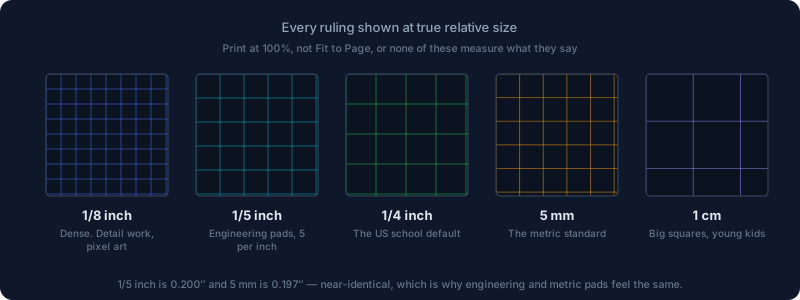
1/4 inch is the US school default, and the one most American maths homework assumes. Big enough to count quickly, small enough to plot on.
1/5 inch is the engineering ruling, five squares to the inch, the one on the green-tinted pads sold for engineering courses. Its whole appeal is that inches divide into it cleanly.
5 mm is the standard almost everywhere else, and the default for squared exercise books across Europe and Asia. Here is the detail that surprises people: 1/5 inch is 0.200″ and 5 mm is 0.197″. They are 1.6% apart, which is why an engineering pad and a metric pad feel identical in the hand and are not interchangeable if you are measuring.
1/8 inch is for detail work: dense sketching, or cross-stitch charts where one square is one stitch.
1 cm is for young children, and for anything that has to be legible across a room.
Dot grid is not a grid at all once you write on it. The dots give you alignment without lines running through your work, which is why bullet journals standardised on 5 mm dots.
Choosing for a job rather than a preference: knitting and cross-stitch want small squares. Tabletop maps want 1/4 inch, because the five-foot square is the convention the rules already assume.
Keep the Lines Faint
A black grid competes with your pencil. Real graph paper uses a light blue or grey line, weak enough that your own marks sit on top of it and strong enough to still follow. Light blue had a second advantage historically: it dropped out when a page was photographed for reproduction.
If you are printing a lot of it, faint lines also use meaningfully less ink than a dark grid across an entire sheet.
Making a Sheet
- Open Graph Paper
- Pick a ruling — 1/8 in, 1/5 in engineering, 1/4 in, 5 mm, 1 cm, or a 5 mm dot grid
- Set the page size to the paper in your printer, not the one the download defaulted to
- Print at 100% with fit-to-page off, then measure ten squares
It generates in your browser and downloads as a PDF, so there is no upload and no account. For ruled rather than squared paper, Lined Paper does narrow, college and wide rulings the same way.
Two Things Worth Knowing
Generate at the size you print. Resizing afterwards reintroduces the exact scaling error this whole article is about — but if you are stuck with a sheet in the wrong size, Fix Page Size is the least-bad way to convert it.
Double-sided grids want heavier paper. Standard 80 gsm office paper shows the grid from the other side clearly enough to be distracting. Engineering pads sidestep this by convention: the grid is printed on the back of each sheet, so the writing surface stays clean and the lines show faintly through.
Graph paper is the rare thing where the file is trivial and the printing is where it goes wrong. Get the scale right once, and every sheet after that is correct.
Make a sheet of graph paper — generated in your browser, nothing uploaded.