 Rohman
Every printer driver on earth can print 2 pages per sheet. Tick the box, hit print, done. Then someone asks for the handout version by email, and you realize you have nothing to send — the layout lived in a checkbox, not in a file. A print setting and a document are not the same thing, and that gap is where people actually get stuck.
The Setting That Evaporates
N-up, the generic name for putting several pages on one sheet, exists in two completely different places, and nearly every guide to this conflates them.
The printer driver does it at print time. The PDF stays untouched; the driver tiles the pages as it rasterises them for the printer. It's fast and it's already installed, but it can't be shared or archived, and it behaves differently depending on which machine runs it. That last part is why "print 2 pages per sheet not working" is such a durable search: the option sits in a different dialog on macOS than on Windows, and plenty of drivers accept the setting and quietly ignore it.
There's also one specific, documented cause of that failure worth knowing, because it looks exactly like a bug. Acrobat's N-up is independent of the driver's N-up, and Adobe's own instructions say to pick one or the other and never both. Set it in both places and you get two impositions stacked on top of each other — four pages crushed into the quarter-sheet the driver had already allocated for one. People conclude their printer is broken. It did precisely what both dialogs asked.
Baking it into the PDF, on the other hand, produces a new file whose pages genuinely contain two pages each. It opens the same way on every device and survives an email attachment; the print shop down the road gets exactly what you saw on screen. The tradeoff is a second file to keep track of.
Neither approach is universally correct. Printing one copy for yourself right now? Use the driver. Anyone else ever opening it? Make the file.
How Far You Can Push It
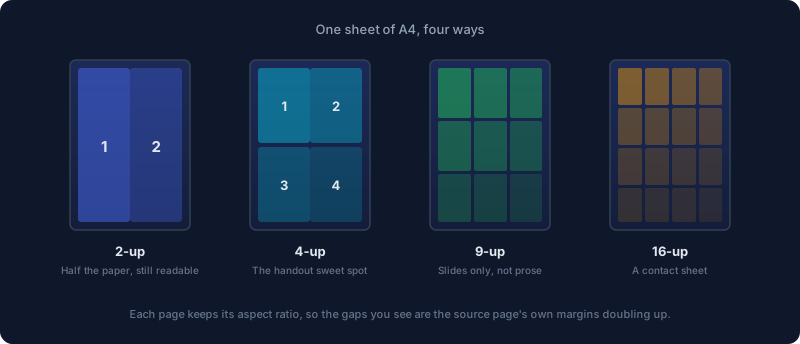
2-up halves your paper and stays comfortably readable for ordinary documents. 4-up is the handout standard — slide decks survive it well, and most people can still read a 12pt body font. 9-up and 16-up are contact sheets: fine for recognising a page you already know, useless for reading one you don't.
The limit is set by the source material, not the grid. A slide deck at 4-up works because slides carry maybe forty words a page. Try that with a dense journal article and you'll need a magnifying glass.
The Margin Trap
Scaling a page down scales its margins down with it, except now you have four scaled-down margins meeting in the middle of the sheet, plus the grid's own gutters. A document with generous one-inch margins turns into four small islands of text separated by an ocean of white, and the readable text ends up smaller than it needed to be. This is what makes a first N-up attempt look worse than it should.
The fix is to crop before you impose. Trim the source margins first, then run N-up on the cropped file. The same paper gives you noticeably larger text. Crop PDF does the trimming; run it first and the difference is not subtle.
While you're there: a mixed-size document imposes badly, because each page gets fitted into a fixed cell independently. Fix Page Size normalises the stack first.
N-Up Isn't Booklet Printing, and Getting It Wrong Wastes a Ream
People conflate these two constantly.
N-up places pages in reading order: 1 and 2 on the first sheet, 3 and 4 on the next. Read it flat, in the order the numbers run.
A booklet needs imposition — pages reordered so that after printing double-sided and folding down the middle, the numbers land in sequence. For an eight-page booklet on two sheets, the front of sheet one carries pages 8 and 1, its back carries 2 and 7, sheet two carries 6 and 3, then 4 and 5. Fold the stack and it reads 1 through 8.
Run plain 2-up on something you intend to fold and you get a stack of paper with the pages in scrambled order. Use PDF Booklet when there's a fold involved and N-Up PDF when there isn't.
Doing It
- Open N-Up PDF
- Drop your file in
- Pick 2, 4, 9, or 16 pages per sheet
- Set the output page size and orientation, then apply
Pages are placed left to right, then top to bottom, which is the reading order you want for a handout. Landscape usually beats portrait for 2-up, because two portrait pages side by side fit a landscape sheet almost exactly.
Everything runs in your browser; the file is never uploaded. That matters more than it sounds for the documents people actually impose — exam papers before an exam, board packs, unreleased decks, medical forms. A print-shop upload form is a strange place to put any of those.
Worth Knowing
- Check the first sheet before printing eighty. It's the cheapest proof you'll get.
- Duplex often flips on the wrong edge by default: for 2-up landscape output you usually want short-edge binding, since long-edge gives you every second sheet upside down.
- Keep the original file. An imposed PDF is a derivative for printing, not a replacement: the text stays selectable, but the page geometry no longer matches what anyone else has.
- Toner matters as much as paper here. 4-up quarters your sheet count on a long document; run compression afterward to keep the emailed version small.
Put multiple pages on one sheet here — in your browser, nothing uploaded.