 Rohman
The school supply list says college ruled. The shelf has both, they look identical through the packaging, and nobody on the aisle can tell you why it matters.
It comes down to 1.6 millimetres.
The Actual Numbers
American lined paper comes in three standard rulings, and the whole argument is about the distance between one line and the next.
Wide ruled, also sold as legal ruled, has 11/32 inch spacing — 8.7 mm.
College ruled, properly called medium ruled, has 9/32 inch — 7.1 mm. It also carries a vertical margin about 1¼ inches in from the left edge. This is the common one in the United States.
Narrow ruled has 1/4 inch — 6.4 mm, for people with small handwriting or anyone trying to fit more onto the page.
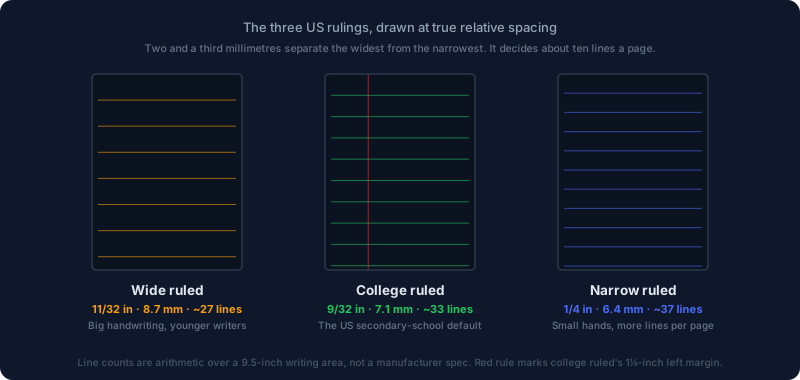
Over a 9.5-inch writing area that works out to roughly 27 lines wide ruled, 33 college ruled, and 37 narrow. The 1.6 mm between the two common rulings buys about six extra lines per side, which across a semester of notes is a real stack of paper.
It Is About Handwriting Size, Not Age
The usual advice is that wide ruled is for younger children and college ruled is for older students. That is roughly how it gets sold, and it is the wrong way to choose.
The thing that actually matters is how tall you write. Handwriting that naturally sits 7 mm tall will collide with itself on college ruled and leave awkward gaps on wide. Descenders from one line crash into the ascenders of the next, and the page stops being legible to the person who has to mark it.
The test takes ten seconds: write two lines of your normal handwriting on unlined paper and measure from one baseline to the next. Land near 8.7 and you want wide. Near 7.1, college. If you are comfortably under 7, narrow will give you a third more page.
Children get pushed toward wide ruled because motor control develops before handwriting shrinks, not because of their age as such. An adult with large handwriting is not doing anything wrong by preferring it.
The Paper for Children Learning to Write Is a Different Thing
Worth separating out, because it gets lumped in: manuscript ruled paper is not just wider.
It has rows of three lines rather than one, with the middle line of each set dotted. The dotted line is where lowercase letters stop and the solid lines are the baseline and the cap height, so a child can see where each part of a letter belongs. The D'Nealian method is built around it, and at least one curriculum teaches it with a house metaphor — upstairs, downstairs and basement.
If you are printing for a child who is still forming letters, that is the paper you want, and neither wide nor college ruled will do the job.
For what it is worth, this is a local convention rather than a universal one. French schools use Seyès ruling, a grid of fine horizontal lines with heavier lines every 8 mm and vertical lines throughout, which looks alarming to anyone who grew up with American paper and is entirely ordinary there.
Why Print Your Own
Two reasons, and neither is about saving money on a pad of paper.
The first is that you are not restricted to the three standards. If your handwriting sits at 8 mm, no manufacturer makes your paper. Generating it means you pick the spacing, rather than picking the closest compromise off a shelf.
The second is that a pad has a fixed margin, a fixed hole punch and a fixed number of lines. Printing your own means the margin goes where your binder needs it, which matters more than it sounds if you are left-handed and the standard left margin is on the wrong side of the page for you.
Making a Sheet
- Open Lined Paper
- Pick narrow, college or wide ruling
- Set the page size to the paper that is actually in your printer
- Print at 100% with fit-to-page turned off
That last step is the one people skip, and it is why home-printed ruled paper so often measures wrong. Print dialogs default to shrinking the page to fit the printable area, which quietly rescales your 7.1 mm ruling to something else. The graph paper guide goes through the scaling problem properly, and everything in it applies here.
Sheets generate in your browser and download as a PDF. Nothing is uploaded and there is no account.
If you want squares rather than lines, Graph Paper covers 1/8 in through 1 cm plus a dot grid.
Two Practical Notes
Match the ruling to the pen, not only the hand. A broad-nibbed fountain pen or a 1.0 mm gel pen lays down a thicker stroke that needs the room wide ruled gives it. A fine liner is happy on narrow.
Check the margin before you print fifty. The left margin position is the thing people notice only after the holes punch through it.
Make a sheet of lined paper — generated in your browser, nothing uploaded.