 Rohman

Quick answer: College ruled paper spaces its horizontal lines 9/32 inch (7.1 mm) apart. Wide ruled — also sold as legal ruled — spaces them 11/32 inch (8.7 mm) apart, about a sixteenth of an inch more per line. Match the ruling to how tall your own handwriting actually sits, not to your age or grade, and if none of the three standard US sizes fit, generate a sheet at the exact spacing you need instead of picking the closest compromise off a shelf.
The school supply list says college ruled. The shelf has both, they look identical through the packaging, and nobody on the aisle can tell you why it matters.
It comes down to 1.6 millimetres.
The Actual Numbers
American lined paper comes in three standard rulings, and the whole argument is about the distance between one line and the next — the same three fractions Wikipedia's ruled paper entry lists as the US convention.
Wide ruled, also sold as legal ruled, has 11/32 inch spacing — 8.7 mm.
College ruled, properly called medium ruled, has 9/32 inch — 7.1 mm. It also carries a vertical margin about 1¼ inches in from the left edge. This is the common one in the United States.
Narrow ruled has 1/4 inch — 6.4 mm, for people with small handwriting or anyone trying to fit more onto the page.
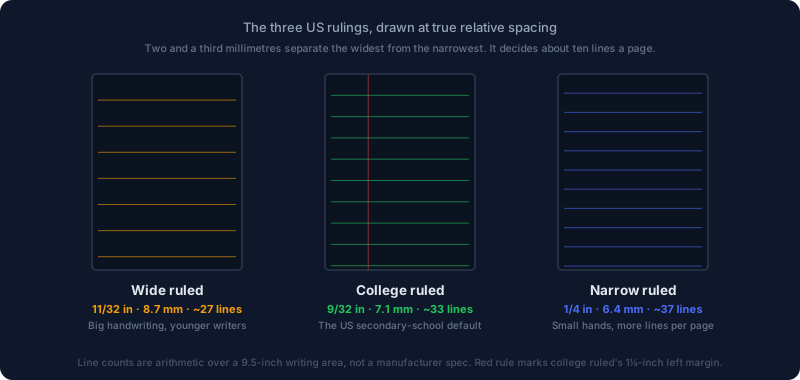
Put side by side, over a fixed 9.5-inch writing area, the three rulings look like this:
| Ruling | Spacing (in) | Spacing (mm) | Lines per 9.5 in page | Typical use |
|---|---|---|---|---|
| Wide ruled (legal ruled) | 11/32 in | 8.7 mm | ~27 | Legal pads, early grade school, larger handwriting |
| College ruled (medium ruled) | 9/32 in | 7.1 mm | ~33 | Standard US notebook and filler paper |
| Narrow ruled | 1/4 in | 6.4 mm | ~37 | Small handwriting, dense note-taking |
The 1.6 mm between the two common rulings buys about six extra lines per side, which across a semester of notes is a real stack of paper.
None of this is set by an ANSI or ISO specification — search for one and you will not find it. It is a convention that notebook and legal-pad manufacturers converged on independently, closely enough that treating the three fractions above as fixed beats guessing at your own spacing.
It Is About Handwriting Size, Not Age
The usual advice is that wide ruled is for younger children and college ruled is for older students. That is roughly how it gets sold, and it is the wrong way to choose.
The thing that actually matters is how tall you write. Handwriting that naturally sits 7 mm tall will collide with itself on college ruled and leave awkward gaps on wide. Descenders from one line crash into the ascenders of the next, and the page stops being legible to the person who has to mark it.
How Do I Know Which Ruling Fits My Handwriting?
The test takes ten seconds: write two lines of your normal handwriting on unlined paper and measure from one baseline to the next. Land near 8.7 and you want wide. Near 7.1, college. If you are comfortably under 7, narrow will give you a third more page. Do the test with whatever pen you actually reach for day to day — a broad-nibbed fountain pen or a marker sits taller on the page than a fine liner even in the same handwriting, so the ruling that suits your gel pen can still crowd your fountain pen.
Children get pushed toward wide ruled because motor control develops before handwriting shrinks, not because of their age as such. An adult with large handwriting is not doing anything wrong by preferring it.
The Paper for Children Learning to Write Is a Different Thing
Worth separating out, because it gets lumped in: manuscript ruled paper is not just wider.
It has rows of three lines rather than one, with the middle line of each set dotted. The dotted line is where lowercase letters stop and the solid lines are the baseline and the cap height, so a child can see where each part of a letter belongs — Zaner-Bloser's manuscript paper templates show the structure exactly. The D'Nealian method is built around it, and at least one curriculum teaches it with a house metaphor — upstairs, downstairs and basement.
The D'Nealian method itself is a specific, dated thing: a manuscript-to-cursive handwriting curriculum developed between 1965 and 1978 by Michigan teacher Donald N. Thurber, built on the older Palmer Method, using slanted print letters that already resemble their cursive counterparts so the later jump to joined-up writing is smaller. It caught on quickly enough after its 1978 introduction to push the previously dominant Zaner-Bloser method into decline across many US schools (Wikipedia).
If you are printing for a child who is still forming letters, that is the paper you want, and neither wide nor college ruled will do the job.
For what it is worth, this is a local convention rather than a universal one. French schools use Seyès ruling: heavy horizontal lines spaced 8 mm apart with three lighter guide lines spaced 2 mm apart in between, plus a vertical margin line about 16 mm from the left edge (Wikipedia). It looks alarming to anyone who grew up with American paper and is entirely ordinary there.
Why Print Your Own
Two reasons, and neither is about saving money on a pad of paper.
The first is that you are not restricted to the three standards. If your handwriting sits at 8 mm, no manufacturer makes your paper. Lined Paper's ruling menu has a Custom option for exactly this case: a slider running from 8 to 48 points in two-point steps, roughly 0.11 to 0.67 inch, or 2.8 to 16.9 mm, wide enough to land on a spacing none of the three named presets cover. Generating it means you pick the spacing, rather than picking the closest compromise off a shelf. The same page-size selector also covers a run of e-ink tablet screens — reMarkable, Supernote and Boox among them — so someone writing on a tablet rather than paper can still match a ruling to the device's actual screen dimensions instead of a generic page size that leaves a dead margin down one edge.
The second is that a pad has a fixed margin, a fixed hole punch, and a fixed number of lines. Printing your own gets you past the last one directly: set the page count to exactly what the job needs, from a single sheet to a hundred-page set, instead of buying a 70-page pad that runs out mid-semester, and set how much blank space sits above the first line and below the last rather than accepting whatever a manufacturer left. The vertical margin rule itself stays fixed at the standard 1.25 inches from the left edge no matter what else you change — that is true of a real pad too, and it is one convention this generator matches on purpose rather than making adjustable.
Making a Sheet
- Open Lined Paper
- Pick narrow, college or wide ruling — or switch to Custom for a spacing between them
- Set the page size to the paper that is actually in your printer
- Print at 100% with fit-to-page turned off
That last step is the one people skip, and it is why home-printed ruled paper so often measures wrong. Print dialogs default to shrinking the page to fit the printable area, which quietly rescales your 7.1 mm ruling to something else. The graph paper guide goes through the scaling problem properly, and everything in it applies here.
Sheets generate in your browser and download as a PDF. Nothing is uploaded and there is no account.
If you want squares rather than lines, Graph Paper covers 1/8 in through 1 cm plus a dot grid.
Two Practical Notes
Match the ruling to the pen, not only the hand. A broad-nibbed fountain pen or a 1.0 mm gel pen lays down a thicker stroke that needs the room wide ruled gives it. A fine liner is happy on narrow.
Check the margin before you print fifty. The left margin position is the thing people notice only after the holes punch through it.
Frequently Asked Questions
What's the actual difference between college ruled and wide ruled paper?
A sixteenth of an inch. College ruled spaces its horizontal lines 9/32 inch (7.1 mm) apart; wide ruled spaces them 11/32 inch (8.7 mm) apart. That 1.6 mm gap compounds over a full page: college ruled fits roughly 22% more lines in the same vertical space, which is the entire reason two separate presets exist instead of one default ruling.
Is "wide ruled" the same as "legal ruled"?
Yes. Both names describe the identical 11/32 inch (8.7 mm) spacing — "wide ruled" is the classroom-supply name, "legal ruled" is the name printed on a standard yellow legal pad. Legal pads kept that spacing into adulthood even as most people moved on to college ruled once their handwriting got smaller, which is why the two names describe one measurement used in two different settings.
What is narrow ruled paper, and who uses it?
The tightest of the three US rulings, at 1/4 inch (6.4 mm) between lines. It suits smaller handwriting and packs more lines onto a page than college or wide ruled, which makes it a common choice for dense note-taking or for anyone deliberately trying to fit more onto fewer sheets.
Which ruling should I start with if I don't know my handwriting size yet?
College ruled. It's the default most US notebook and filler paper ships as when the package just says "ruled" without specifying which, and it's this generator's starting ruling too, for the same reason. Run the ten-second handwriting test above once you have a sheet in hand, and switch to narrow or wide if it points somewhere else — but college ruled is the right first guess for most adults.
What is manuscript ruled paper, and how is it different from these three?
Manuscript ruled paper is not a fourth spacing option — it is a different structure entirely, built for children who are still learning to form individual letters rather than for anyone already writing along a continuous line. Instead of one rule per line, it draws rows of three lines with the middle one dotted, marking the baseline, the lowercase letter height and the cap height separately so a child can see where each part of a letter belongs. Narrow, college and wide ruled all assume the writer already knows where a letter starts and stops; manuscript ruled paper is what teaches that first.
What if I'm outside the US and none of these three match my paper?
Wide, college and narrow ruled are an American convention — most of the world uses something else, like French Seyès ruling or a metric exercise-book spacing. The horizontal spacing is still yours to set through the Custom ruling option regardless of where you're printing from, and the page itself doesn't have to be US Letter either: Lined Paper also generates on A4, A3 and A5, so the sheet matches the paper you actually stock rather than the convention someone else designed for a different market.
Can I generate a line spacing that isn't narrow, college, or wide?
Yes. Lined Paper's ruling menu switches to a Custom option with a slider running from 8 to 48 points — about 2.8 mm to 16.9 mm — in two-point steps, which covers everything from tighter than narrow ruled to looser than wide. That's the option for handwriting that doesn't land on one of the three standard sizes, or for anyone printing for a bold marker or a low-vision reader who needs more room than even wide ruled gives.
Does generating lined paper here upload my file or require an account?
No. The PDF is built entirely in your browser, with no account and nothing to upload — there's no source document involved in the first place, just the ruling and page settings you picked. Close the tab when you're done and nothing about the sheet you made, or the fact that you needed one, is stored anywhere else.
Make a sheet of lined paper — generated in your browser, nothing uploaded.