 Rohman
It is late, the room is dark, and the PDF you have to finish is a rectangle of pure white light. Everything else on your machine went dark years ago. This one file did not get the message.
There are two ways to fix that, they are not variations of the same thing, and picking the wrong one costs you something you will not notice until later.
The File Has No Opinion About Colour
Here is the thing that makes PDF dark mode more awkward than dark mode anywhere else: a PDF is a description of marks on a page. It carries no theme, no alternate palette to switch to. Black text on white paper is not a style choice in the file. It is the content.
So there is nothing to toggle. Something has to actively change what you see.
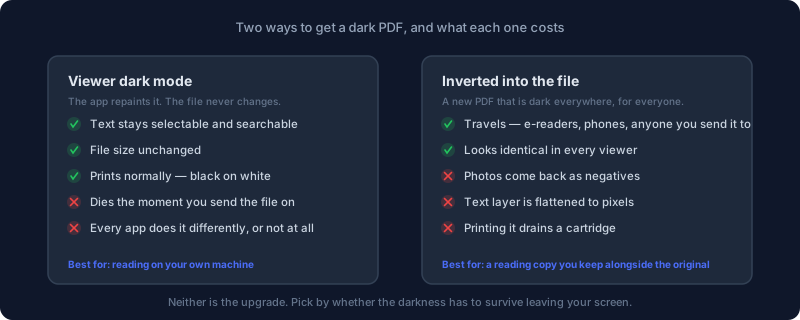
The viewer repaints it. Acrobat has one buried in its accessibility settings, and Sumatra and Foxit both ship their own. The browsers mostly do not: desktop Chrome, Edge and Firefox have no dark mode for PDF content at all, and the Firefox request has been sitting open for about six years. That gap is why so many people end up hunting for an extension. Chrome on Android is the odd exception, where dark mode does carry over to the PDF.
Whichever one you use, the file on disk never changes: text stays selectable and the size stays the same. Printing still comes out normal black-on-white, because the document itself was never touched.
Or you invert the file. Now you have a new PDF that is dark on every device, for everyone you send it to. That portability is the whole point, and it is also where the costs come from.
If you are reading on your own machine, use the viewer. If the darkness needs to survive being emailed, loaded onto an e-reader, or opened by someone whose reader has no dark mode at all, you need it in the file.
The Part Most Tools Do Not Mention
"Invert PDF colours" describes two structurally different operations, and almost nothing tells you which one you just used.
A colour transform rewrites the colour instructions inside the page while leaving the text objects alone. Searchable text stays searchable, because searchability lives in the text objects, not in the colours they happen to render in.
A rasterise-and-recolour renders each page to a bitmap, inverts the pixels, and builds a new PDF out of the images. Visually the result can be identical. Underneath, every word is now a picture of a word: nothing to select, nothing to copy, nothing to search, nothing for a screen reader to read.
Most inverters in circulation, ours included, work the second way. That is a real tradeoff and it deserves to be stated plainly rather than buried: run a PDF through our Invert Colors tool and you get a dark file that looks right everywhere and has no text layer left. The file also gets bigger, because page images at reading resolution cost more than the text they replaced.
The practical rule that follows: invert a copy, keep the original. The inverted file is your reading copy, while the original stays searchable and printable. If you only ever keep one, keep the one with the words in it.
Inversion Also Ruins Your Photographs
Flip every channel and text goes white-on-black, which is what you wanted. The same operation turns every photograph into a colour negative. Faces go grey-green, skies go orange. A chart whose colours meant something — red for loss, green for gain — now means the opposite.
Diagrams are the worst case, because they look plausible. An inverted heat map is still a heat map. It is just lying to you.
Smarter approaches exist. Inverting lightness while preserving hue is far less jarring, and the better tools detect images and leave them alone, inverting only the page behind. That is exactly what Apple's Smart Invert does, and why it looks so much less broken than a plain colour flip. If your document is mostly prose, straight inversion is fine. If it is full of photographs or colour-coded figures, invert it, look at the figures, and be ready to go back to the original for those pages.
Does Dark Mode Actually Help Your Eyes
This is where the confident internet and the actual literature part company.
The best-built studies on reading performance favour dark text on light backgrounds. A 2013 study of 84 younger and 85 older adults found dark-on-light won on both visual acuity and proofreading accuracy, in both age groups, with no difference in reading speed and no difference in reported eye strain. The authors' recommendation was explicit: dark characters on light backgrounds, regardless of the reader's age.
The mechanism turns out to have nothing to do with colour. A light background is simply a brighter screen: brighter light contracts your pupil, a smaller pupil reduces the effect of your eye's optical imperfections and deepens focus, and you get a sharper image on the retina. A companion study held total luminance constant while flipping polarity, and the advantage disappeared completely. Brightness was doing all the work, not colour.
Which is exactly why the answer flips for some people. Readers with cataracts or other light-scattering conditions in the eye have been measured reading 10 to 15% better on light-on-dark. Scatter is what makes a bright background hostile, and that population is the reason operating systems have shipped invert-colours accessibility settings for a quarter of a century.
Two more things worth getting straight, because they are constantly conflated:
Dark mode is not a blue-light filter. The melatonin and sleep research is about the spectrum of light, and dark mode does not change colour temperature. It reduces how much light your screen emits, which is a genuine and separate benefit at night. Night Shift and f.lux do the other thing. Running both is reasonable; assuming one is the other is not.
Newer research measuring physical fatigue instead of accuracy leans the other way. Work measuring blink rate alongside pupil and flicker response in low light has found dark mode less fatiguing, even while people's stated preference still went to light mode. Reading accurately and reading comfortably are not the same question.
So: in a bright room, reading something you need to get right, light background. At midnight, grinding through a long document, dark. With a light-scattering eye condition, dark, and that one is not a preference.
Inverting a PDF
- Open Invert Colors
- Drop your PDF in
- Let it process, then download the inverted copy
It runs entirely in your browser, so the file is never uploaded. That matters when the document is a contract or a medical report, and it is the reason the tool works without an account.
Prefer something gentler than full inversion? Adjust Colors gives you brightness and contrast directly, which is often enough to take the glare off a scanned page without flipping anything. For a bright scan that is merely harsh rather than blinding, that is the better tool.
Before You Hit Print
Don't. An inverted page is close to worst-case toner coverage: a normal page is mostly bare paper with a thin scattering of ink, and inverting swaps that ratio entirely. There is no dark paper to save you. Print from the original and read from the inverted copy.
Check a figure-heavy page before committing to the whole document. Page one is usually prose and tells you nothing about what happened to the charts on page forty.
Run OCR first if the text matters. A scanned PDF has no text layer to lose, but if you want one, OCR it before inverting rather than after: recognition works better on dark-on-light.
Dark mode for PDFs is worth having, just not as an upgrade to the document itself. Treat it as a second copy, chosen for whatever room you are reading in.
Invert your PDF here, all inside your browser, with nothing uploaded.