 Rohman
Few document tasks generate as much quiet panic as a watermark that has outlived its purpose. A final partnership agreement is ready for execution, but every page remains defaced by a diagonal red "DRAFT" stamp applied during internal review. A commercial lease was edited in an unactivated desktop utility, burning a permanent vendor evaluation banner across the header. An archival land deed was scanned on pre-printed stationery carrying a faint "COPY" pantograph that causes automated OCR recognition to misread boundary numbers. When users attempt to remove watermark from pdf documents using traditional desktop software or quick internet searches, they quickly discover that most tools either fail completely or destroy the document in the process.
The fundamental disconnect stems from a widespread misunderstanding of how digital documents are assembled. Most people assume a watermarked document is like a flattened JPEG photograph, where removing a stamp requires "AI inpainting" or manual cloning tools to guess what pixels used to exist underneath. In reality, over $85%$ of born-digital Portable Document Format files adhere to the ISO 32000 specification, where a watermark is not a permanent stain on an image. It is an independent vector object, a discrete content-stream drawing sequence, or a tagged artifact sitting within a hierarchical object tree.
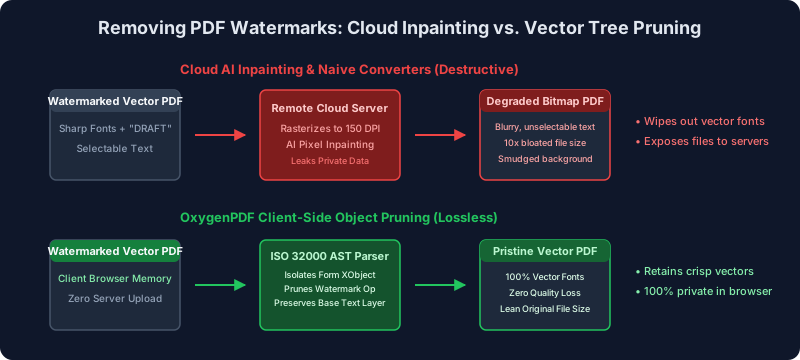
Approaching watermark removal as an image-editing challenge leads to catastrophic document damage. Cloud-based conversion websites quietly rasterize your crisp vector pages into blurry 150 DPI bitmaps, destroying typography, eliminating text searchability, and leaking confidential client records to unvetted remote servers. Meanwhile, Adobe Acrobat’s built-in "Remove Watermark" feature frequently throws its infamous alert—"No watermark found on this page"—because it only recognizes stamps created by its own proprietary metadata. Understanding the underlying object architecture of a PDF allows you to strip obsolete markings cleanly using dedicated client-side tools like Remove Watermark without compromising vector fidelity or confidentiality.
1. Legitimate Use Cases vs. Ethical Boundaries
Before examining the technical mechanics of object manipulation, it is vital to establish the legal and ethical boundaries of document alteration. Watermarks serve vital communicative purposes during drafting, but operational workflows regularly create legitimate administrative needs for removal.
+-------------------------------------------------------------------------+
| LEGITIMATE ADMINISTRATIVE REASONS TO REMOVE WATERMARKS                  |
+-------------------------------------------------------------------------+
| • Finalizing contracts whose source Word/InDesign files were lost       |
| • Clearing trial evaluation banners left by unactivated enterprise PCs  |
| • Stripping pre-printed background pantographs that break OCR pipelines |
| • Resolving automated double-watermarking glitches from document queues |
+-------------------------------------------------------------------------+
Legitimate Administrative Scenarios
- Retiring Obsolete Workflow Markers: Documents undergo multi-stage approvals. Stamps such as
"PRELIMINARY","INTERNAL USE ONLY", or"EMBARGOED"are essential during draft phases. Once formal counter-signatures occur, those markers must be retired. If the original author has left the firm or the editable source file has been lost, pruning the obsolete marker directly from the PDF vector stream is the only practical solution. - Clearing Evaluation Stamps from Licensed Workplaces: Organizations frequently own multi-seat enterprise licenses, but an employee on a new laptop inadvertently edits a mission-critical document using an unactivated trial install. Rebuilding a complex 80-page compiled filing from scratch costs billable days; stripping the vendor demo XObject restores the document instantaneously.
- Unblocking Optical Character Recognition (OCR): Archival invoices, deeds, and medical charts often feature pre-printed security patterns (e.g., light void pantographs) intended to deter analog photocopiers. When fed into digital OCR engines, these background patterns create severe character confusion, causing commas to be read as periods and turning critical account numbers into garbled text. Removing the background layer restores OCR accuracy.
- Correcting Document Automation Collisions: Enterprise pipelines that assemble multi-party PDFs (combining tools like DocuSign, headless Chrome, and custom Python scripts) often apply stamps at multiple stages. A contract stamped as
"CONFIDENTIAL"by legal may be merged with an appendix where a secondary script stamps"DRAFT"across the same coordinates, rendering body paragraphs completely illegible.
The Legal Framework: DMCA § 1202
Document editing utilities are neutral technologies, but legal statutes establish clear boundaries regarding copyright attribution:
- Copyright Management Information (CMI): Under Section 1202 of the U.S. Digital Millennium Copyright Act (DMCA), as well as equivalent provisions in the World Intellectual Property Organization (WIPO) Copyright Treaty and European Union directives, it is unlawful to knowingly remove or alter CMI with the intent to induce, enable, facilitate, or conceal copyright infringement.
- Prohibited Removal: Stripping agency watermarks (such as Getty Images, Shutterstock, or Adobe Stock previews), removing photographer credits, or deleting publisher copyright lines (
© 2026 Corporation) to redistribute creative works without authorization carries strict statutory damages. - Authorized Cleanup: Removing internal operational status stamps from documents owned by your organization, or clearing trial software banners from proprietary filings, constitutes lawful administrative document maintenance.
2. The Five Structural Types of PDF Watermarks (ISO 32000)
Under ISO 32000-1 and ISO 32000-2, a PDF is not a flat canvas. It is a directed graph of indirect objects linked together through a Cross-Reference Table (xref). Watermarks are implemented through five distinct structural paradigms, each requiring a tailored removal strategy:
+-------------------------------------------------------------------------+
| THE FIVE WATERMARK IMPLEMENTATION PATTERNS IN ISO 32000                 |
+-------------------------------------------------------------------------+
|                                                                         |
|  [Type 1: Inline Operators] ──> BT ... (DRAFT) Tj ... ET in /Contents   |
|                                                                         |
|  [Type 2: Form XObjects]    ──> External sub-stream invoked via "Do"   |
|                                                                         |
|  [Type 3: Tagged Artifacts] ──> /Artifact BDC ... Content ... EMC       |
|                                                                         |
|  [Type 4: Annotations]      ──> Interactive /Subtype /Watermark or /Stamp|
|                                                                         |
|  [Type 5: Raster Bitmaps]   ──> Pixels baked into a scanned image       |
|                                                                         |
+-------------------------------------------------------------------------+
Type 1: Content Stream Text & Path Operators (Inline Stamping)
The most common technique writes PostScript-like drawing operators directly into the page's /Contents stream. The generator pushes the graphics state, applies a rotation transformation matrix, sets transparency, renders text, and pops the stack:
q                                            % Push graphics state to stack
/GS1 gs                                      % Apply 20% alpha transparency
0.85 0.15 0.15 rg                            % Set fill color to subtle red
/F1 54 Tf                                    % Set font F1 at 54 points
0.7071 0.7071 -0.7071 0.7071 180 240 cm      % Rotate 45 degrees counter-clockwise
BT                                           % Begin Text Object
0 0 Td                                       % Position text cursor
(STRICTLY CONFIDENTIAL) Tj                   % Render the watermark string
ET                                           % End Text Object
Q                                            % Pop graphics state (restore stack)
In this pattern, the watermark text exists within the exact same stream as body paragraphs. Naive search-and-replace scripts often corrupt the byte offsets declared in the file's xref table, breaking the entire document. Proper vector removal requires parsing the operator stream into an Abstract Syntax Tree (AST), isolating the self-contained q ... Q graphics state block containing the rotation and transparency instructions, and excising the block while recalculating cross-reference tables.
Type 2: Form XObjects (Re-usable Vector Sub-Streams)
Professional layout software (including Adobe Acrobat, InDesign, and Cairo-based PDF engines) avoids polluting the main page content stream. Instead, it encapsulates the watermark as an independent sub-document called a Form XObject:
- Inside the page dictionary (
/Type /Page), the/Resources << /XObject >>dictionary defines a named reference:/Resources << /XObject << /WatermarkFm1 42 0 R >> >> - The page
/Contentsstream requires only two operators to invoke the entire watermark:q /WatermarkFm1 Do % Paint external Form XObject Q - Object
42 0 Rcontains its own self-contained stream, bounding box (/BBox [0 0 612 792]), font definitions, and transparency group.
Because the watermark is isolated inside an external object, removal is exceptionally clean: the engine prunes the /WatermarkFm1 Do operator from the content stream and removes the reference from the /XObject dictionary, leaving the primary document text completely untouched.
Type 3: Tagged PDF Artifacts (/Artifact)
In accessibility-compliant PDFs adhering to PDF/UA (Universal Accessibility) and Section 508, non-semantic background elements must be explicitly hidden from screen readers so assistive technology does not repeat "Confidential" on every page.
These watermarks are wrapped in Marked Content sequences:
/Artifact << /Type /Pagination /Subtype /Watermark >> BDC
q
/F1 48 Tf
(DRAFT) Tj
Q
EMC
The /Artifact tag provides a clear structural signature. An intelligent parser can scan the content stream for BDC (Begin Marked Content Dictionary) tags tagged with /Subtype /Watermark and excise everything up to the matching EMC (End Marked Content) operator.
Type 4: Interactive Annotations (/Subtype /Watermark or /Stamp)
Some applications implement watermarks as interactive annotation objects stored in the page’s /Annots array rather than within the /Contents stream.
These annotations exist outside the page content stream entirely. Removing them does not require parsing drawing operators; the engine simply inspects the /Annots array, identifies entries where /Subtype equals /Watermark or /Stamp, and splices the reference out of the array.
Type 5: Raster Bitmaps (Scanned Paper)
When physical documents containing pre-printed watermarks are fed into a scanner, the resulting PDF does not contain vector operators, font glyphs, or XObjects. The entire page is a single raster image (/Subtype /Image).
Because the watermark pixels are physically merged with the character pixels during scanning, object-level vector pruning is mathematically impossible. Cleaning scanned watermarks requires luminosity filtering, thresholding, or OCR text re-extraction rather than vector pruning.
3. Why Conventional Removal Methods Fail
When users search for how to remove watermark from pdf, they typically encounter three flawed approaches that introduce severe operational and security liabilities.
| Removal Technique | How It Works | Typography & Quality Impact | Security & Privacy Profile | Primary Failure Mode |
|---|---|---|---|---|
| Adobe Acrobat "Remove Watermark" | Searches page dictionary for proprietary /PieceInfo metadata. |
100% Vector Lossless (when it works). | High: Local desktop execution. | Rigid Lock-in: Fails with "No watermark found" on any watermark not generated by Acrobat itself. |
| Cloud AI "Inpainting" Sites | Converts pages to raster JPEG bitmaps; runs pixel inpainting on remote servers. | Destructive: Wipes out vector text, blurs edges, destroys searchability, inflates file size 10x. | Fails Compliance: Transmits confidential legal/financial files across the public web to third-party disks. | Blurry output; character distortion; unselectable text; data harvesting. |
| Superficial White Rectangle Overlays | Draws opaque white boxes over watermark regions. | Moderate: Leaves vectors intact, but creates ugly white voids over underlying text. | Security Hole: Underlying watermark text remains fully extractable via clipboard copy or code inspection. | Obscures valid body text; does not delete sensitive data; looks amateurish. |
| OxygenPDF Client-Side Pruning | Parses ISO 32000 object tree; removes watermark XObjects/operators in local browser memory. | 100% Vector Lossless: Original fonts, crisp vector lines, and searchability remain untouched. | Maximum Security: 100% client-side WebAssembly execution; zero server uploads; works offline. | Cannot separate merged pixels on single-layer scanned paper images. |
4. The Adobe Acrobat Myth: The /PieceInfo Metadata Trap
Many corporate users assume that paying $240 annually for Adobe Acrobat Pro guarantees the ability to remove any watermark. In practice, Acrobat’s Edit PDF > Watermark > Remove command fails on a vast majority of real-world documents, generating the frustrating error:
+-------------------------------------------------------------+
| Adobe Acrobat                                               |
| (i) No watermark was found on this page.                   |
|                                     [      OK      ]        |
+-------------------------------------------------------------+
Why Acrobat Fails
Acrobat does not perform heuristic pattern recognition on PDF content streams. It does not look for diagonal text or transparent lettering. Instead, Acrobat relies entirely on a proprietary metadata tracking dictionary stored under the document or page catalog:
/PieceInfo <<
  /ADBE_CompoundType <<
    /DocData 48 0 R
    /Private <<
      /WatermarkType /Standard
      /WatermarkID (Acrobat_Watermark_2026)
    >>
  >>
>>
When you click "Remove Watermark," Acrobat checks whether the page carries this exact /PieceInfo signature.
If the watermark was generated by Microsoft Word, Google Docs, PDF-XChange, Foxit, Nitro, Wondershare, Sejda, Canva, or a print-to-PDF driver, it lacks Adobe's proprietary metadata tag. Acrobat treats the watermark as ordinary, immutable page artwork and refuses to touch it. Users are left stranded, believing the watermark is permanently baked in when it is actually just an unindexed Form XObject.
5. The Cloud Inpainting Hazard: Quality Loss and Data Exposure
Frustrated by Acrobat's limitations, users often turn to search engines and land on free cloud-based "watermark remover" web tools. These services represent the worst possible trade-off in document processing.
THE CLOUD INPAINTING CATASTROPHE:
[Vector PDF (200 KB)] ──> [Uploaded to Cloud VM] ──> [Rasterized to 150 DPI JPEG (8 MB)]
                                                              │
                                                              ▼
[Blurry Non-Searchable PDF (12 MB)] <── [AI Pixel Inpainting Clones Over Background]
The Quality Destruction
Cloud removal utilities rarely manipulate PDF object trees. Instead, their backend pipeline executes a destructive sequence:
- Rasterization: The server renders the vector PDF page into a lossy raster image (typically at a mediocre 150 to 200 DPI). Every crisp vector character glyph—rendered using scalable Bezier curves—is permanently converted into a grid of colored pixels.
- AI Pixel Inpainting: An image segmentation model detects the watermark text and runs convolutional neural network inpainting to fill the surrounding area with estimated background texture. This frequently creates blurry smudges, distorted character edges, and uneven artifacts.
- Re-Packaging: The backend wraps the blurry JPEG inside a new PDF wrapper.
The consequences are devastating: text selection is lost, document searchability drops to zero, file sizes swell by $500%$ to $2,000%$, and printed documents display jagged, amateurish edges.
The Security and Compliance Nightmare
Uploading documents to free cloud processing sites exposes your organization to severe security vulnerabilities:
- Confidentiality Leaks: Documents carrying watermarks like
"STRICTLY CONFIDENTIAL","DO NOT DISTRIBUTE", or"ACQUISITION TARGET"are, by definition, an organization’s most sensitive records. Uploading them to random multi-tenant cloud servers exposes proprietary data to potential harvesting operations, data breaches, and third-party storage logging. - Regulatory Non-Compliance: Transmitting employee records, patient charts, or client financial audits across the internet to unvetted overseas server farms constitutes an active breach of GDPR Article 28, HIPAA, and standard non-disclosure agreements.
6. How Client-Side Vector Pruning Works
To preserve document fidelity and guarantee total privacy, watermark removal must operate directly on the ISO 32000 object tree within a secure, local-first environment.
OxygenPDF's Remove Watermark tool executes entirely inside your browser using WebAssembly (WASM) and high-performance typed arrays:
+-------------------------------------------------------------------------+
| OXYGENPDF CLIENT-SIDE OBJECT PRUNING PIPELINE                           |
+-------------------------------------------------------------------------+
|                                                                         |
|  [Step 1: In-Memory Ingestion]                                          |
|  Loads PDF into browser memory via HTML5 File API. Zero server upload.  |
|                                                                         |
|  [Step 2: Object Tree Inspection]                                       |
|  Parses /XObject, /Annots, and /Contents streams into structured AST.   |
|                                                                         |
|  [Step 3: Signature Detection & Classification]                         |
|  Identifies Form XObjects, rotation matrices (cm), and /Artifact tags.  |
|                                                                         |
|  [Step 4: Surgical Vector Pruning]                                      |
|  Excises watermark operators without re-compressing base text glyphs.   |
|                                                                         |
|  [Step 5: Xref Rebuilding & Serialization]                              |
|  Rebuilds cross-reference tables and generates pristine vector PDF.     |
|                                                                         |
+-------------------------------------------------------------------------+
The Engineering Advantage
- True Vector Preservation: Because the engine operates on PostScript drawing operators rather than bitmap pixels, underlying fonts, line weights, vector graphics, and embedded metadata remain completely untouched. Text remains crisp at $1,000%$ zoom.
- Deterministic Privacy: Processing occurs within your browser's local memory sandbox. You can open your browser’s DevTools Network tab or disconnect your network adapter entirely; zero bytes leave your computer.
- Cross-Vendor Compatibility: Because it inspects universal ISO 32000 structural properties rather than vendor-specific
/PieceInfotags, it neutralizes watermarks created by Microsoft Word, PDF-XChange, Wondershare, Sejda, and legacy print drivers with equal precision.
7. Step-by-Step Guide: How to Remove Watermarks Cleanly
Follow this operational protocol to clean your documents without quality loss or compliance risks:
WATERMARK REMOVAL WORKFLOW:
1. Verify document type (born-digital vector vs. scanned paper).
2. Load file into local client-side memory via OxygenPDF.
3. Select and preview detected watermark layers.
4. Execute surgical vector pruning and download pristine file.
Phase 1: Diagnosing Your PDF
Before attempting removal, confirm how the watermark was applied:
- The Selection Test: Open the document in any PDF viewer. Click and drag your cursor over the body text.
- If the text highlights cleanly, your document is a born-digital vector PDF (Types 1–4). It can be cleaned with $100%$ lossless quality.
- If the entire page selects as a single blue rectangle, or if text cannot be highlighted, your document is a scanned image (Type 5). Vector pruning will not apply; you must use OCR text extraction or image thresholding.
Phase 2: Removing the Watermark with OxygenPDF
- Access the Tool: Open Remove Watermark in your web browser.
- Load Your Document: Drag and drop your watermarked PDF into the browser workspace. The file is parsed instantaneously in local memory.
- Inspect Detected Layers: The engine scans the document object graph, categorizing detected elements:
- Form XObjects tagged with watermark properties.
- Interactive
/Subtype /Watermarkor/Stampannotations. - Prominent background text operator blocks.
- Execute Removal: Select the target watermark layers and click Remove Watermark. The engine excises the offending object references and rebuilds the file structure.
- Download Pristine PDF: Save your cleaned file. Verify in your viewer that the watermark is completely gone, text remains razor-sharp, and selectable typography is fully preserved.
8. Complementary Post-Processing Workflows
Cleaning an obsolete watermark is often part of a broader document finalization sequence. OxygenPDF provides integrated companion utilities to finish preparing your file:
- Applying Permanent Legal Redaction: If your document contains sensitive Social Security numbers, account balances, or confidential clauses that must be permanently hidden, do not rely on white rectangles. Use Redact PDF to surgically delete sensitive character codes and vector paths from the underlying file structure.
- Adding Official Status Stamps: Once an obsolete draft marker is cleared, apply approved corporate status markings using Insert Watermark. For detailed best practices on configuring opacity and rotation angles, explore our guide on How to Watermark a PDF Without Uploading.
- Flattening Layers for Final Distribution: Lock form fields, signature stamps, and vector artwork permanently into the base content stream using Flatten PDF. This prevents recipients from moving or modifying your final layout.
- Compressing for Distribution: If the original watermarked file accumulated redundant resources, streamline file weight using Compress PDF to ensure effortless email delivery.
9. Frequently Asked Questions
Can Adobe Acrobat remove watermarks created in Microsoft Word or other software?
Rarely. Adobe Acrobat’s built-in "Remove Watermark" command relies on proprietary /PieceInfo metadata generated exclusively when watermarks are applied within Acrobat. Watermarks inserted by Microsoft Word, Google Docs, PDF-XChange, or other tools lack this tag. Acrobat treats them as permanent page artwork and reports "No watermark found." Specialized object parsers like Remove Watermark inspect universal ISO 32000 content streams directly, allowing them to clear third-party stamps cleanly.
Does removing a watermark make the underlying text blurry?
Not when using a true vector object pruner. Vector watermark removal operates on internal PostScript-like drawing operators, deleting only the watermark instructions while leaving original text glyphs and fonts untouched. The only time documents become blurry is when users rely on low-grade cloud "AI inpainting" tools that rasterize vector pages into lossy JPEG bitmaps.
Can I remove a watermark from a scanned paper document?
Only through image processing. On a scanned document, the page is a flat raster bitmap where watermark ink and text ink share the same pixels. Because there are no distinct vector objects or font streams in the file, object pruning cannot separate them. Scanned files require grayscale contrast thresholding or re-processing through OCR text recognition.
What is the difference between removing a watermark and redacting a PDF?
Watermark removal is designed to clear semi-transparent status labels (such as "DRAFT" or "SAMPLE") across pages to reveal clean underlying content. Redaction, by contrast, is a legal security procedure designed to permanently obliterate sensitive information (such as personal identifying information or bank details). Redaction removes both the visible characters and the underlying byte codes, ensuring data cannot be recovered through text search, clipboard copying, or script inspection. For confidential data masking, always use Redact PDF.
Is it safe to upload confidential watermarked contracts to online removers?
No. Traditional web-based converters upload your files to remote, multi-tenant cloud servers where documents are stored, cached, and processed on shared hardware. For documents carrying confidential or proprietary draft markings, this introduces severe data leakage risks and violates GDPR and HIPAA requirements. OxygenPDF executes all operations client-side in your browser’s local memory, guaranteeing that zero document bytes ever leave your device.
Conclusion
Watermarks are essential tools for managing document lifecycles, but clearing them when they become obsolete should not force you to accept degraded, blurry bitmaps or compromise confidential client data on public cloud servers.
By understanding the ISO 32000 object architecture, you can approach document cleanup with precision. Avoid the metadata traps of legacy desktop editors, reject destructive cloud inpainting websites, and utilize modern client-side object pruning.
Restore your documents to pristine condition: launch Remove Watermark and clean your vector files today—instant, watermark-free, and completely private in your browser.